
.png)

The acceleration of the energy transition, geopolitical fragmentation, and the reorganisation of global supply chains are redrawing the map of industrial advantage. The capacity to develop and industrialise clean technologies at scale is becoming a defining determinant of long-term competitiveness and of strategic autonomy. Supply chains that cannot be secured domestically become dependencies, which, in an era of deliberate economic fragmentation, can easily translate into vulnerabilities.
Italy enters this phase under significant structural pressure. Industrial energy costs remain among Europe’s highest, contributing to a prolonged contraction in manufacturing output. The risk is forward-looking: if Italy does not build domestic manufacturing capacity in the clean technology sectors now taking shape, it will find itself importing the technologies on which its future competitiveness and energy security depend. Countries that industrialise these technologies first will capture the value chains, set the standards, and host the production capacity. Those that do not will be buyers in markets shaped by others.
Clean technologies address these pressures directly. Domestic production of energy storage, advanced electrification systems, and industrial decarbonisation technologies reduces exposure to volatile import prices, rebuilds manufacturing capacity, and opens new industrial segments with global export potential. The European Union has recognised this: the Clean Industrial Deal and the Net Zero Industry Act together frame cleantech as the engine of European reindustrialisation, setting domestic production targets, creating frameworks for lead markets, and embedding local content requirements.
A generation of European cleantech companies has developed world-leading technologies in batteries, electrolysers, industrial decarbonisation, and advanced materials. However, few of which have reached commercial scale on the continent where they were invented. The obstacle is not technological capability, nor the absence of political will: it is the absence of the structural conditions under which promising innovations can be converted into bankable, scalable industrial projects.
First-of-a-kind (FOAK) projects — the initial commercial-scale deployment of a technology demonstrated at pilot level — are the critical inflection point between innovation and industrial leadership, and the point at which the financing system most consistently fails.
FOAK projects typically require €50 to €100 million for a first commercial facility, an order of magnitude larger than venture capital rounds and well beyond the risk tolerance of conventional project finance. Venture investors operate on five to ten-year return horizons incompatible with infrastructure assets, while project finance lenders require proven technology and predictable revenue streams that FOAK projects cannot yet provide. The result is a valley of death: projects with demonstrated technology and genuine market potential that cannot close financing because they fall between two asset classes with incompatible requirements.
Where this gap persists, innovation relocates to jurisdictions where enabling conditions exist. The value chains, manufacturing capacity, and strategic autonomy that come with domestic production go with it.

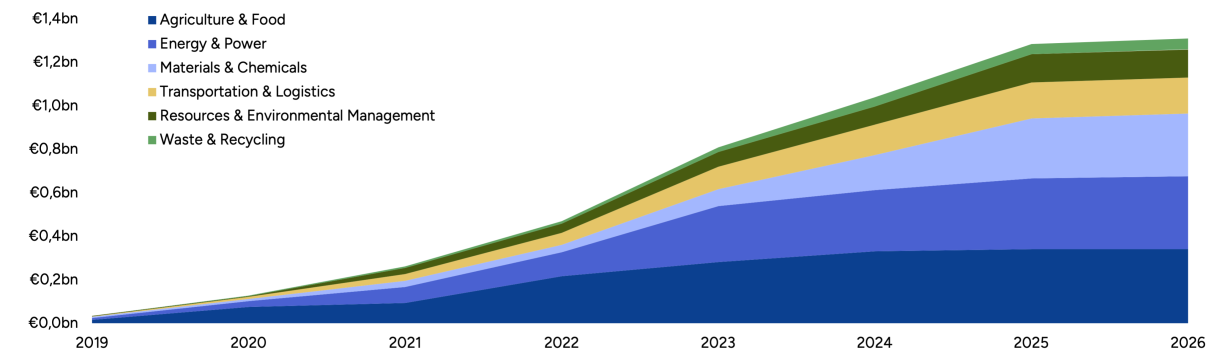
Since 2019, Italian cleantech investment has grown at a CAGR of 68.5%, reaching €1.3 billion across six key verticals. The trajectory is strong across long-duration energy storage, industrial emissions reduction, innovative molecules and advanced materials, electrification, small-scale storage, and circular economy solutions. Italian innovators are building technologies with genuine industrial potential — and facing the same structural barriers that prevent European cleantech from scaling broadly.
Italy is the EU’s second largest manufacturing economy. Its industrial structure combines manufacturing districts with decades of embedded process knowledge, specialised supply chains, and a density of mid-sized firms with the flexibility to adopt new technologies and the scale to aggregate meaningful demand. Engineering capabilities in advanced materials, precision mechanics, electromechanics, and industrial chemistry are directly relevant to the clean technology sectors with the highest growth potential. These are precisely the conditions under which cleantech demonstrations can be validated, production processes adapted, and deployment brought to industrial scale.
Where strategic technologies face structural financing barriers, fragmented demand, and regulatory frameworks not designed for their risk profile, coordinated public intervention is what allows private capital to move with confidence. The countries that have successfully industrialised clean technologies at scale have done so through deliberate alignment of policy, capital, and demand around shared industrial objectives. Italy has the foundations: turning them into durable industrial capacity requires the same ambition across three structural levers.







%201.svg)


